Introduction to Forest Ecosystems
Forests are among the most diverse and essential ecosystems on Earth. They play a vital role in maintaining ecological balance, supporting biodiversity, regulating climate, and sustaining human livelihoods. From towering mountain ranges to coastal wetlands and equatorial rainforests, forests exist in many forms—each uniquely adapted to its environment.
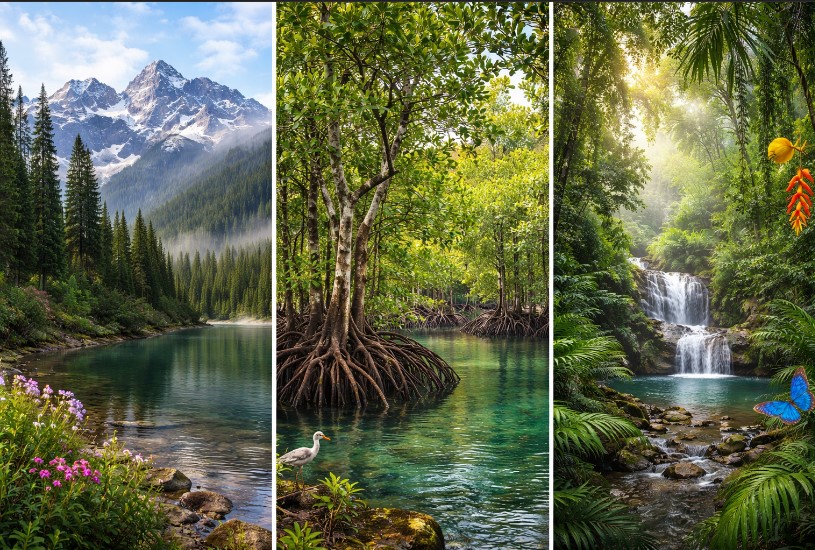
Understanding different forest types helps us appreciate their ecological importance and the need for their conservation. This comprehensive guide explores three major forest categories: mountain forests, mangrove forests, and tropical forests. Each of these ecosystems differs in climate, vegetation, wildlife, and environmental function.
Mountain Forests: Nature at High Altitudes
What Are Mountain Forests?
Mountain forests, also known as montane forests, are found in high-altitude regions such as hills and mountain ranges. These forests are shaped by altitude, temperature, rainfall, and slope conditions. As elevation increases, vegetation changes dramatically—a phenomenon known as altitudinal zonation.
These forests are commonly found in major ranges like the Himalayas, Andes, Rocky Mountains, and Alps. In India, they are especially prominent in the Himalayan belt, covering regions like Himachal Pradesh, Uttarakhand, Sikkim, and Arunachal Pradesh.
Key Characteristics of Mountain Forests
Climate Conditions
Mountain forests experience varied climatic conditions depending on altitude:
- Lower altitudes: Moderate temperature with higher rainfall
- Mid-altitudes: Cooler temperatures with dense vegetation
- Higher altitudes: Cold, windy, often snow-covered
Temperature generally decreases with altitude, while precipitation varies based on geographic location.
Soil Type
Soil in mountain forests is typically:
- Thin and less fertile at higher altitudes
- Rich in organic matter in lower regions
- Prone to erosion due to steep slopes
Vegetation Adaptation
Plants in mountain forests are specially adapted to survive harsh conditions:
- Needle-like leaves reduce water loss
- Conical tree shapes help shed snow
- Deep roots anchor plants in rocky terrain
Types of Mountain Forests
Tropical Montane Forests
These forests occur in tropical regions at higher elevations.
Features:
- High rainfall
- Dense vegetation
- Presence of cloud forests
Common trees:
- Oak
- Laurel
- Magnolia
Temperate Mountain Forests
Found at mid-altitudes, these forests experience moderate temperatures.
Features:
- Seasonal variation
- Mixed vegetation
Common trees:
- Pine
- Deodar
- Fir
Alpine Forests (Subalpine and Alpine Zones)
Located at very high altitudes, near or above the tree line.
Features:
- Extremely cold climate
- Sparse vegetation
Common vegetation:
- Shrubs
- Mosses
- Lichens
Biodiversity in Mountain Forests
Flora Diversity
Different plant species thrive at different elevations:
- Lower regions: Dense forests with broad-leaved trees
- Mid regions: Coniferous forests
- Higher regions: Alpine vegetation
Fauna Diversity
Mountain forests are home to unique wildlife species such as the Snow leopard, Red panda, and Himalayan tahr. Birds like eagles and pheasants are also commonly found.
Importance of Mountain Forests
Water Conservation
Mountain forests play a crucial role in maintaining the water cycle:
- Act as watersheds
- Regulate river flow
- Prevent floods
Climate Regulation
These forests help in:
- Absorbing carbon dioxide
- Maintaining temperature balance
- Influencing rainfall patterns
Soil Protection
Vegetation cover prevents soil erosion and reduces the risk of landslides on steep slopes.
Livelihood Support
Local communities depend on mountain forests for:
- Fuelwood
- Medicinal plants
- Grazing land
Challenges Faced by Mountain Forests
Deforestation
Logging and land clearing for agriculture are major concerns.
Climate Change
Rising temperatures are affecting vegetation patterns and wildlife habitats.
Soil Erosion
Uncontrolled human activities increase landslide risks.
Tourism Pressure
Unregulated tourism leads to waste generation and environmental degradation.
Conservation of Mountain Forests
Sustainable Forestry
Balancing resource use with conservation ensures long-term sustainability.
Afforestation
Planting trees in degraded areas helps restore forest cover.
Protected Areas
Governments establish national parks and wildlife sanctuaries to conserve biodiversity.
Community Participation
Involving local communities ensures effective and sustainable conservation.
Role of Mountain Forests in India
India’s mountain forests, especially in the Himalayas, are ecologically significant:
- Source of major rivers like the Ganga River and Brahmaputra River
- Habitat for endangered species
- Crucial for agriculture and climate stability
Government initiatives and conservation programs aim to protect these valuable ecosystems.
Mangrove Forests: Guardians of the Coast
What Are Mangrove Forests?
Mangrove forests are unique coastal ecosystems found in tropical and subtropical regions. They grow in saline or brackish water along shorelines, estuaries, river deltas, and lagoons. These forests consist of salt-tolerant trees and shrubs known as mangroves, which thrive in conditions that would be hostile to most plant species.
In India, mangrove forests are widely found in regions like the Sundarbans, Bhitarkanika National Park, and coastal belts of Tamil Nadu and Andhra Pradesh.
Key Characteristics of Mangrove Forests
Saline Environment
Mangroves grow in high-salinity environments where most plants cannot survive. They have developed special mechanisms to tolerate and manage salt levels.
Tidal Influence
These forests are strongly influenced by tidal movements:
- High tide submerges the roots
- Low tide exposes the root systems
This constant fluctuation makes mangrove ecosystems highly dynamic.
Unique Root Systems
Mangrove trees have specialized root structures:
- Stilt roots provide stability in soft mud
- Pneumatophores (breathing roots) help absorb oxygen
These roots often extend above the ground, giving mangroves their distinctive look.
Types of Mangrove Forests
Riverine Mangroves
Found along rivers and estuaries, these mangroves receive freshwater and nutrients, making them highly productive.
Fringe Mangroves
Located along coastlines, these act as the first barrier against sea waves and storms.
Basin Mangroves
Found in inland depressions with limited water exchange, often having higher salinity levels.
Adaptations of Mangrove Vegetation
Salt Filtration
Some mangrove species filter salt through their roots, while others expel it through their leaves.
Vivipary (Live Germination)
Seeds germinate while still attached to the parent plant, increasing their chances of survival when they drop into muddy waters.
Aerial Roots
These roots grow above the soil surface to absorb oxygen from the air, essential for survival in waterlogged conditions.
Biodiversity in Mangrove Forests
Flora
Mangrove forests include plant species such as:
- Rhizophora
- Avicennia
- Sonneratia
These species form dense vegetation that supports various life forms.
Fauna
Mangrove ecosystems support rich wildlife, including:
- Fish and crustaceans
- Crabs and mollusks
- Birds like herons and kingfishers
They are also home to the iconic Bengal tiger, especially in the Sundarbans.
Ecological Importance of Mangrove Forests
Coastal Protection
Mangroves act as natural barriers against:
- Cyclones
- Storm surges
- Tsunamis
Their dense roots reduce wave energy and protect coastal regions.
Carbon Sequestration
Mangroves store large amounts of carbon, making them important in reducing climate change impacts. They are often called “blue carbon ecosystems.”
Nursery Grounds for Marine Life
Many marine species depend on mangroves for breeding and early development stages.
Soil Stabilization
Mangrove roots bind soil and reduce coastal erosion.
Economic Importance
Livelihood Support
Mangrove forests provide:
- Fishing opportunities
- Timber and fuelwood
- Honey and medicinal resources
Fisheries Contribution
They support commercial and local fisheries by acting as breeding grounds for aquatic species.
Threats to Mangrove Forests
Coastal Development
Urbanization, ports, and industries are leading to mangrove destruction.
Pollution
Oil spills, plastic waste, and industrial discharge damage these ecosystems.
Climate Change
Rising sea levels and temperature changes threaten mangrove survival.
Overexploitation
Excessive resource use leads to ecosystem degradation.
Conservation Efforts
Protected Areas
Regions like the Sundarbans National Park are conserved to protect biodiversity.
Restoration Projects
Planting mangrove saplings helps restore damaged ecosystems.
Community Participation
Local communities play a vital role in sustainable conservation.
Government Initiatives
Policies and regulations help control deforestation and pollution.
Mangroves in India: A Closer Look
India has significant mangrove cover along its coastline:
- The Sundarbans is the largest mangrove forest in the world
- Bhitarkanika National Park is rich in biodiversity
- Coastal states are actively promoting conservation
These forests are crucial for protecting coastal populations and maintaining ecological balance.
Tropical Forests: Earth’s Biodiversity Powerhouses
What Are Tropical Forests?
Tropical forests are dense, lush forests found near the equator, where the climate is warm and humid throughout the year. These forests receive abundant rainfall and support some of the richest biodiversity on Earth.
They are mainly located between the Tropic of Cancer and the Tropic of Capricorn, covering regions in South America, Africa, Southeast Asia, and parts of India.
Famous examples include the Amazon Rainforest, the Congo Basin, and in India, the Western Ghats and Andaman and Nicobar Islands.
Key Characteristics of Tropical Forests
Climate Conditions
Tropical forests experience:
- High temperatures (usually between 20°C to 30°C)
- Heavy rainfall throughout the year
- High humidity levels
This stable climate allows continuous plant growth.
Dense Vegetation
Vegetation in tropical forests is thick and layered. Trees grow tall and close together, forming a continuous canopy that blocks sunlight from reaching the forest floor.
Rich Soil (But Nutrient Cycling)
Although the vegetation is dense, the soil is often not very fertile. Nutrients are quickly recycled through decomposing organic matter.
Types of Tropical Forests
Tropical Rainforests
These are the most dense and biodiverse forests.
Features:
- Rainfall above 200 cm annually
- Evergreen trees
- Multi-layered structure
Tropical Deciduous Forests
Also known as monsoon forests.
Features:
- Seasonal rainfall
- Trees shed leaves during dry seasons
Common in: India and Southeast Asia
Tropical Dry Forests
These forests receive less rainfall compared to rainforests.
Features:
- Sparse vegetation
- Longer dry seasons
Structure of Tropical Forests
Emergent Layer
The topmost layer with very tall trees rising above the canopy.
- Receives maximum sunlight
- Home to birds and large insects
Canopy Layer
A dense layer of tree crowns forming a “roof” over the forest.
- Rich in biodiversity
- Many animals live here
Understory Layer
Located below the canopy, receiving limited sunlight.
- Shrubs and smaller trees grow here
Forest Floor
The bottom layer with very little sunlight.
- Decomposition occurs rapidly
- Home to insects and fungi
Biodiversity in Tropical Forests
Flora
Tropical forests contain a vast variety of plant species:
- Hardwood trees
- Climbers and lianas
- Epiphytes like orchids
Fauna
These forests are home to numerous animal species such as:
- Monkeys and apes
- Elephants
- Birds, reptiles, and amphibians
Notable species include the Jaguar in the Amazon Rainforest and the Asian elephant in the Western Ghats.
Importance of Tropical Forests
Climate Regulation
Tropical forests play a major role in regulating the Earth’s climate:
- Absorb large amounts of carbon dioxide
- Help maintain global temperature balance
Oxygen Production
They contribute significantly to oxygen production, often referred to as the “lungs of the Earth.”
Biodiversity Conservation
Tropical forests support more than half of the world’s plant and animal species.
Water Cycle Maintenance
These forests influence rainfall patterns and help maintain the global water cycle.
Economic Importance
Resources
Tropical forests provide valuable resources:
- Timber
- Medicinal plants
- Fruits and nuts
Livelihoods
Millions of people depend on tropical forests for food, shelter, and income.
Threats to Tropical Forests
Deforestation
Large-scale clearing for agriculture, logging, and urbanization is a major threat.
Climate Change
Changes in temperature and rainfall patterns affect forest health.
Illegal Logging
Unregulated timber extraction leads to biodiversity loss.
Habitat Destruction
Wildlife habitats are destroyed due to human activities.
Conservation Efforts
Protected Areas
National parks and reserves help protect tropical forests.
Sustainable Practices
Eco-friendly forestry and agriculture reduce environmental impact.
Reforestation
Planting trees helps restore degraded forest areas.
Global Initiatives
International programs aim to reduce deforestation and promote conservation.
Tropical Forests in India
India has significant tropical forest regions:
- The Western Ghats is a biodiversity hotspot
- The Andaman and Nicobar Islands host dense rainforests
- Central and northeastern states have extensive forest cover
These forests are crucial for ecological balance and economic development.
Final Thoughts
Mountain, mangrove, and tropical forests each play a unique and vital role in maintaining Earth’s ecological balance. While mountain forests regulate water systems and climate, mangroves protect coastlines, and tropical forests support unmatched biodiversity.
Understanding these ecosystems is the first step toward protecting them. Sustainable practices, conservation efforts, and awareness are essential to preserve these natural treasures for future generations.
FAQs:
The three main forest types covered are mountain forests, mangrove forests, and tropical forests. Each type differs in climate, location, vegetation, and ecological importance.
Mangrove forests act as natural barriers that protect coastlines from cyclones, storm surges, and erosion. Regions like the Sundarbans play a critical role in safeguarding nearby communities.
Tropical forests have warm temperatures, high rainfall, and stable climatic conditions throughout the year. This environment supports a wide variety of plant and animal species, especially in regions like the Amazon Rainforest.
Mangrove trees have special adaptations such as salt-filtering roots, salt-excreting leaves, and aerial roots that help them survive in saline and waterlogged conditions.
Altitudinal zonation refers to the change in vegetation and climate as altitude increases. Different plant species grow at different elevations in mountain forests.
Tropical forests absorb large amounts of carbon dioxide and release oxygen, helping regulate the Earth’s atmosphere and climate.