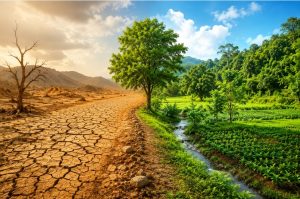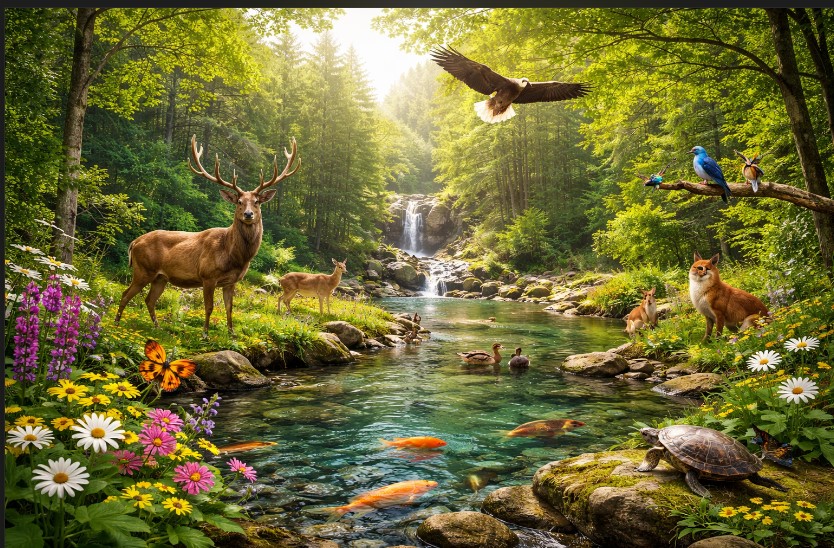
Ecological balance is the foundation of life on Earth. Every organism, from the tiniest microorganism to the largest mammal, plays a role in maintaining the stability of ecosystems. Among all living components, flora (plants) and fauna (animals) are the most visible and essential contributors to this balance. They regulate natural processes, support biodiversity, and ensure that ecosystems continue to function smoothly over time.
Without flora and fauna, Earth’s ecosystems would collapse, leading to food shortages, climate instability, and the breakdown of life-support systems. Understanding their importance is not just an academic concept—it is necessary for survival and sustainable development.
This section explores how flora and fauna form the backbone of ecological balance and why their existence is critical for life on Earth.
Understanding Ecological Balance
Ecological balance refers to a stable state in an ecosystem where living organisms and their environment interact in harmony. In such a system:
- Energy flows smoothly from producers to consumers
- Nutrients are continuously recycled
- Populations remain within natural limits
- No single species dominates excessively
Flora and fauna are the two primary biological components that regulate these processes. Plants act as producers, while animals function as consumers and decomposers (directly or indirectly). Together, they form a dynamic system that supports life.
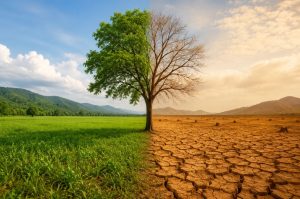
When this balance is disturbed—due to deforestation, pollution, climate change, or habitat destruction—the entire ecosystem becomes unstable.
Role of Flora in Ecological Balance
Flora includes all plant life such as trees, shrubs, grasses, algae, and flowering plants. Plants are the foundation of almost all ecosystems.
Primary Producers of Energy
Plants are known as primary producers because they convert sunlight into food through photosynthesis. This process is essential because:
- It produces oxygen required for respiration
- It creates glucose, which forms the base of the food chain
- It stores solar energy in a usable form for other organisms
Without plants, life on Earth would not exist because no other organism can directly convert sunlight into food at such a large scale.
Oxygen Production and Carbon Dioxide Absorption
One of the most important ecological roles of flora is maintaining atmospheric balance.
- Plants absorb carbon dioxide during photosynthesis
- They release oxygen as a byproduct
- Forests act as major carbon sinks
This process helps regulate global temperatures and reduces the impact of greenhouse gases. Forests like the Amazon are often called the “lungs of the Earth” because of their massive oxygen output and carbon absorption capacity.
Soil Formation and Protection
Plants play a critical role in maintaining soil health.
- Roots bind soil particles together, preventing erosion
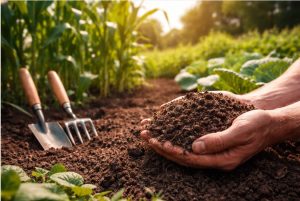
- Leaf litter decomposes to form humus, enriching soil fertility
- Vegetation reduces the impact of rain and wind on bare land
Without plant cover, soil becomes vulnerable to erosion, desertification, and loss of nutrients, which directly affects agricultural productivity.
Water Cycle Regulation
Flora significantly influences the water cycle.
- Trees absorb water through roots and release it through transpiration
- Forests help in cloud formation and rainfall patterns
- Vegetation increases groundwater recharge by slowing runoff
Areas with dense vegetation generally experience better rainfall distribution compared to barren regions.
Role of Fauna in Ecological Balance
Fauna includes all animal life such as mammals, birds, reptiles, insects, and aquatic species. Animals contribute to ecosystem stability in several interconnected ways.
Regulation of Food Chains
Animals maintain balance in food chains through predator-prey relationships.
- Herbivores control plant populations
- Carnivores control herbivore populations
- Omnivores connect multiple levels of the food chain
This ensures that no species grows excessively or disappears completely, maintaining natural equilibrium.
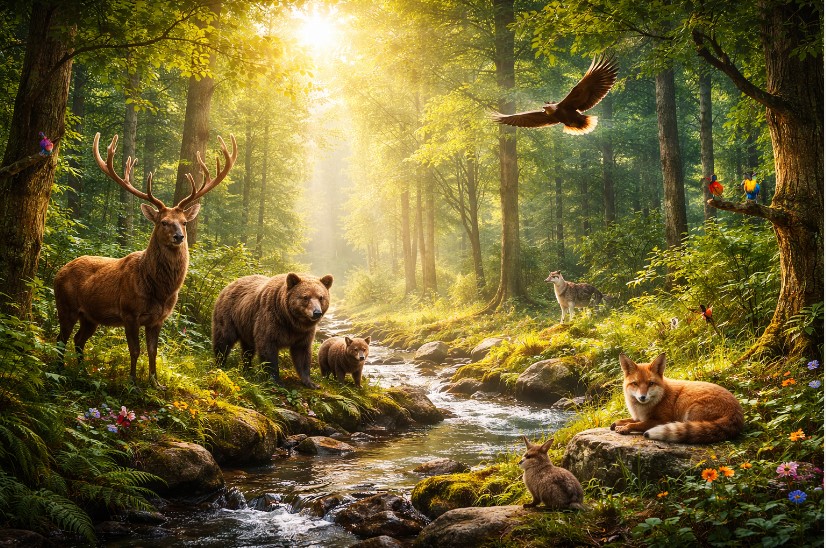
For example, if deer populations grow unchecked due to the absence of predators, vegetation may be overgrazed, leading to habitat destruction.
Pollination of Plants
Many animals, especially insects and birds, play a vital role in plant reproduction.
- Bees transfer pollen between flowers
- Butterflies assist in cross-pollination
- Birds and bats help pollinate certain plant species
Without pollinators, many flowering plants would fail to reproduce, leading to reduced biodiversity and food shortages.
Seed Dispersal
Animals help plants spread their seeds to new areas, ensuring plant survival and diversity.
- Fruits eaten by animals are dispersed through droppings
- Some seeds stick to animal fur and travel long distances
- Birds carry seeds across regions during migration
This natural process helps forests regenerate and expand.
Decomposition and Nutrient Cycling
Certain animals, including insects, worms, and microorganisms, break down dead organic matter.
- Decomposers recycle nutrients back into the soil
- This improves soil fertility and plant growth
- It prevents accumulation of waste in ecosystems
Without decomposition, ecosystems would be filled with dead organic matter, disrupting nutrient cycles.
Interdependence of Flora and Fauna
Flora and fauna are deeply interconnected. Neither can survive independently in a natural ecosystem.
- Plants provide food and oxygen to animals
- Animals provide carbon dioxide needed for photosynthesis
- Animals depend on plants for shelter and habitat
- Plants rely on animals for pollination and seed dispersal
This mutual dependence forms a complex web of life known as the ecosystem. Any disturbance in one component affects the other.
Biodiversity as a Stability Factor
Biodiversity refers to the variety of living organisms in an ecosystem. High biodiversity ensures stability because:
- It increases ecosystem productivity
- It improves resilience against environmental changes
- It reduces the risk of extinction of species
Flora and fauna together contribute to biodiversity. Forests, grasslands, wetlands, and oceans all depend on a balanced combination of plant and animal life.
Importance in Climate Regulation
Flora and fauna collectively help regulate Earth’s climate.
- Forests absorb greenhouse gases
- Oceans store carbon through marine life
- Animals contribute to nutrient cycling, affecting carbon storage
Disruption in biodiversity leads to climate imbalance, increasing risks such as global warming, droughts, and floods.
Human Dependence on Flora and Fauna
Human survival is directly dependent on ecological balance.
- Food supply depends on plants and animals
- Medicines are derived from plant and animal sources
- Oxygen production relies on vegetation
- Livelihoods depend on agriculture, forestry, and fisheries
Any disruption in flora and fauna ultimately impacts human life, health, and economy.
Human Activities and Ecological Disruption
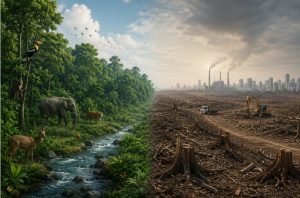
Human development has always depended on natural resources, but excessive exploitation has disturbed the equilibrium of ecosystems. When forests are cleared, wildlife is hunted, or pollution increases, both flora and fauna suffer, leading to cascading ecological effects.
Major human-driven causes of imbalance include deforestation, urban expansion, industrial pollution, overhunting, and unsustainable agriculture.
Each of these activities affects natural systems in interconnected ways, weakening the stability of ecosystems.
Deforestation and Loss of Plant Life
Deforestation is one of the most severe threats to ecological balance. Large-scale cutting of trees for agriculture, construction, and industrial use reduces forest cover dramatically.
When forests disappear:
- Carbon absorption decreases
- Oxygen production reduces
- Soil becomes exposed and erodes quickly
- Wildlife loses natural habitat
This creates a chain reaction where both flora and fauna decline together. Entire ecosystems can collapse when forests are destroyed, especially tropical rainforests that support high biodiversity.
Habitat Destruction and Wildlife Decline
Fauna depends heavily on specific habitats such as forests, wetlands, grasslands, and oceans. When these habitats are destroyed or fragmented:
- Animals are forced to migrate to unsuitable environments
- Food chains become unstable
- Breeding patterns are disrupted
- Species face increased risk of extinction
For example, shrinking forest areas force elephants, tigers, and deer into human settlements, leading to human-wildlife conflict and further population decline.
Pollution and Its Impact on Ecosystems
Pollution affects both plant and animal life in multiple ways.
Air pollution reduces plant photosynthesis efficiency, while water pollution harms aquatic organisms. Soil contamination affects plant growth and reduces soil fertility.
Effects include:
- Toxic chemicals entering food chains
- Death of aquatic species due to contaminated water
- Reduced crop productivity
- Accumulation of harmful substances in animal bodies
Over time, pollution weakens ecosystem resilience and reduces biodiversity.
Climate Change and Ecological Instability
Climate change is a global threat that affects both flora and fauna simultaneously. Rising temperatures, unpredictable rainfall, and extreme weather events disturb natural cycles.
Impacts include:
- Shifts in plant flowering and fruiting seasons
- Migration changes in birds and animals
- Melting of polar habitats affecting species survival
- Increased forest fires and drought conditions
Species that cannot adapt quickly face extinction, leading to reduced biodiversity and ecological imbalance.
Overexploitation of Natural Resources
Excessive use of natural resources disrupts ecological harmony. Overfishing, excessive logging, and hunting reduce population sizes of key species.
Consequences include:
- Collapse of fish populations in aquatic ecosystems
- Loss of medicinal plant species
- Reduction in predator populations affecting food chains
- Economic instability in communities dependent on natural resources
Sustainable use is necessary to ensure long-term ecological stability.
Invasive Species and Ecosystem Imbalance
When non-native species are introduced into an ecosystem, they can disrupt natural balance.
Invasive species often:
- Compete with native species for resources
- Spread diseases
- Alter soil and water conditions
- Reduce biodiversity by dominating habitats
This leads to the decline or extinction of native flora and fauna, weakening ecosystem structure.
Breaking of Food Chains
Food chains are delicate systems that depend on each level being balanced. When one species is removed or reduced:
- Predator-prey relationships collapse
- Population explosions or crashes occur
- Vegetation may be overgrazed or underutilized
- Entire ecosystems become unstable
For example, removing top predators can lead to overpopulation of herbivores, which then overconsume plant life, damaging the entire ecosystem.
Loss of Biodiversity
Biodiversity loss is one of the most serious outcomes of ecological imbalance. It reduces the variety of life forms in ecosystems and weakens their ability to recover from disturbances.
Effects of biodiversity loss include:
- Reduced ecosystem productivity
- Lower resistance to diseases and climate change
- Decline in genetic diversity
- Increased vulnerability of ecosystems
Once species become extinct, their ecological roles are lost permanently.
Impact on Human Life
Ecological imbalance does not only affect nature—it directly impacts humans.
Consequences include:
- Food shortages due to reduced agricultural productivity
- Water scarcity from disrupted water cycles
- Health problems from pollution and environmental toxins
- Economic losses in agriculture, forestry, and fisheries
- Increased natural disasters like floods and droughts
Human well-being is deeply connected to the health of ecosystems.
The Warning Signs of Ecological Imbalance
Nature often shows early warning signs when ecological balance is disturbed.
These include:
- Irregular weather patterns
- Decline in pollinator populations like bees
- Increased frequency of forest fires
- Reduction in bird and animal sightings
- Poor soil fertility and crop yields
Ignoring these signs leads to long-term environmental degradation.
Importance of Conservation Awareness
To restore ecological balance, awareness and responsible actions are essential. Conservation helps protect both flora and fauna and ensures sustainable development.
Key conservation approaches include:
- Protecting forests and wildlife habitats
- Reducing pollution and waste
- Promoting sustainable agriculture
- Supporting biodiversity conservation programs
- Educating communities about environmental responsibility
Human participation plays a crucial role in protecting ecosystems.
Conservation of Flora: Protecting Plant Life
Plants are the foundation of ecosystems, so protecting them is essential for ecological restoration. Conservation of flora involves both protection of natural forests and sustainable use of plant resources.
Efforts include:
- Afforestation and reforestation to restore green cover
- Protection of natural forests from illegal logging
- Conservation of medicinal and endangered plant species
- Development of botanical gardens and seed banks
- Promoting sustainable farming practices
Healthy plant life ensures soil fertility, oxygen production, and climate stability. Without plant conservation, ecosystems cannot recover.
Conservation of Fauna: Protecting Animal Life
Wildlife conservation is equally important because animals maintain food chains, pollination, and nutrient cycles. Protecting fauna ensures that ecosystems remain functional and diverse.
Key measures include:
- Establishment of national parks and wildlife sanctuaries
- Protection of endangered species through breeding programs
- Strict laws against poaching and illegal wildlife trade
- Habitat restoration and wildlife corridors
- Marine conservation for aquatic biodiversity
Conserving animals helps maintain predator-prey balance and prevents ecological collapse.
Role of Protected Areas
Protected areas are regions designated to conserve biodiversity. These include national parks, biosphere reserves, and wildlife sanctuaries.
Their importance lies in:
- Providing safe habitats for endangered species
- Preserving natural ecosystems in their original state
- Supporting scientific research and ecological studies
- Maintaining genetic diversity of flora and fauna
Protected areas act as biodiversity reservoirs that help ecosystems recover from environmental stress.
Sustainable Development and Ecology
Sustainable development ensures that human needs are met without harming ecological balance. It integrates economic growth with environmental protection.
Key principles include:
- Using renewable resources responsibly
- Minimizing environmental pollution
- Promoting eco-friendly technologies
- Balancing development with conservation
When development respects nature, both humans and ecosystems benefit equally.
Importance of Environmental Education
Awareness plays a major role in conservation. Environmental education helps individuals understand the value of flora and fauna and their role in daily life.
Benefits include:
- Encouraging responsible behavior toward nature
- Reducing harmful human activities
- Promoting conservation-oriented thinking
- Inspiring future environmental leaders
Schools, communities, and organizations must actively promote environmental learning to create long-term change.
Role of Communities and Individuals
Every individual can contribute to ecological balance through simple but effective actions.
Examples include:
- Planting trees and maintaining green spaces
- Reducing plastic and chemical waste
- Conserving water and electricity
- Supporting wildlife-friendly products
- Avoiding activities that harm animals or forests
Community participation strengthens conservation efforts and ensures wider impact.
Government and Global Initiatives
Governments and international organizations play a major role in biodiversity protection.
Common initiatives include:
- Wildlife protection laws and environmental regulations
- Climate change agreements and carbon reduction targets
- Forest conservation programs
- Biodiversity action plans
- Global efforts like conservation treaties and ecological partnerships
These initiatives provide a structured framework for protecting ecosystems at a large scale.
Restoration of Damaged Ecosystems
Restoring degraded ecosystems is essential for rebuilding ecological balance.
Restoration methods include:
- Reforestation of deforested land
- Wetland rehabilitation
- Soil restoration through organic farming
- Reintroduction of native species
- Removal of invasive species
Restoration not only improves biodiversity but also enhances climate resilience.
Future of Ecological Balance
The future of ecological balance depends on how well humanity adapts to sustainable living. If conservation efforts continue to grow, ecosystems can recover and thrive.
Positive outcomes of successful conservation include:
- Stable climate conditions
- Rich biodiversity
- Improved agricultural productivity
- Healthier ecosystems and cleaner environments
- Better quality of life for all species
However, failure to act responsibly may lead to irreversible ecological damage.
Final Conclusion
Flora and fauna together form the backbone of ecological balance. Plants provide energy, oxygen, and habitat, while animals regulate ecosystems through food chains, pollination, and nutrient cycling. Their interdependence ensures that nature functions as a self-sustaining system.
Human activities have disrupted this balance, but through conservation, sustainable development, and awareness, it is still possible to restore harmony in nature. Protecting biodiversity is not just an environmental responsibility—it is essential for the survival of all life on Earth.
Safeguarding flora and fauna today ensures a healthier, more stable planet for future generations.
FAQs:
Ecological balance is a stable condition in nature where living organisms and their environment exist in harmony. Energy flow, nutrient cycling, and population control remain naturally regulated.
Flora (plants) are essential because they produce oxygen, absorb carbon dioxide, support food chains, prevent soil erosion, and regulate the water cycle.
Fauna (animals) help maintain food chains, assist in pollination and seed dispersal, recycle nutrients, and control population levels within ecosystems.
Plants provide food, oxygen, and shelter for animals, while animals help plants through pollination, seed dispersal, and carbon dioxide release needed for photosynthesis.
Disturbance can lead to climate change, biodiversity loss, habitat destruction, food shortages, and natural disasters like floods and droughts.
Deforestation reduces oxygen production, increases carbon dioxide levels, destroys habitats, and leads to soil erosion and loss of biodiversity.