Introduction
Forest protection plays a vital role in addressing climate change and preserving environmental balance. Forests cover nearly one-third of the Earth’s land area and act as natural climate regulators by absorbing carbon dioxide, storing carbon, and supporting biodiversity. As climate concerns grow worldwide, protecting forests has become one of the most effective nature-based strategies for reducing greenhouse gas emissions and maintaining ecological health.
However, deforestation, land conversion, and unsustainable resource use continue to threaten forests across the globe. When forests are degraded or destroyed, they lose their ability to absorb carbon and often release stored carbon back into the atmosphere. This accelerates global warming and weakens natural defenses against climate change.
Understanding how forest protection supports climate solutions is essential for governments, businesses, conservationists, and individuals. This article explores the environmental importance of forests, their role in climate regulation, and why protecting them is central to long-term sustainability.
Why Forests Matter for the Planet
Forests provide far more than scenic landscapes. They perform essential ecological functions that support life on Earth.
Key Environmental Benefits of Forests
| Benefit | Role |
|---|---|
| Carbon Storage | Absorb and store atmospheric carbon dioxide |
| Oxygen Production | Release oxygen through photosynthesis |
| Biodiversity Support | Provide habitat for wildlife and plant species |
| Water Regulation | Maintain rainfall cycles and watershed health |
| Soil Protection | Prevent erosion and maintain fertility |
Because of these benefits, forests are considered one of the planet’s most valuable natural resources.
Forests as Carbon Sinks
A carbon sink is a system that absorbs more carbon than it releases. Forests are among the largest natural carbon sinks on Earth.
How Forests Absorb Carbon
Trees take in carbon dioxide from the atmosphere during photosynthesis. They use carbon to grow:
- Trunks
- Branches
- Leaves
- Roots
This carbon remains stored in forest biomass for decades or even centuries.
Long-Term Carbon Storage
In addition to trees, forests store carbon in:
- Forest soils
- Dead wood
- Leaf litter
- Wetland and peatland ecosystems
Together, these make forests critical for long-term carbon sequestration.
How Deforestation Worsens Climate Change
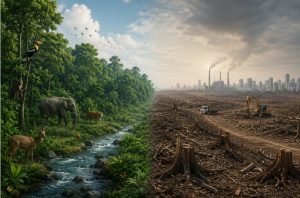
When forests are cut down or burned, stored carbon is released into the atmosphere.
Main Causes of Deforestation
- Agricultural expansion
- Logging
- Urban development
- Mining operations
- Infrastructure construction
Deforestation contributes significantly to global greenhouse gas emissions.
Carbon Emissions from Forest Loss
Forest destruction creates a double climate impact:
Reduced Carbon Absorption
Fewer trees mean less carbon dioxide removed from the atmosphere.
Released Stored Carbon
Burning or decomposing trees releases previously stored carbon.
This combination accelerates atmospheric greenhouse gas accumulation.
Forest Protection as a Climate Strategy
Protecting forests helps preserve their ability to regulate climate naturally.
Why It Is Effective
Forest conservation:
- Prevents new emissions from deforestation
- Maintains carbon sequestration capacity
- Protects biodiversity and ecosystems
- Supports water and weather regulation
Compared to many engineered climate solutions, forest protection is relatively cost-effective.
Role of Forests in Regulating Weather Patterns
Forests influence local and global climate systems.
Temperature Regulation
Trees provide shade and cool surrounding air through transpiration.
Rainfall Generation
Forests release water vapor into the atmosphere, helping form clouds and rainfall.
Climate Stabilization
Large forest systems can influence regional weather and precipitation cycles.
Forests and Biodiversity Conservation
Healthy forests support a large share of Earth’s terrestrial biodiversity.
Forest Habitats Protect
- Mammals
- Birds
- Insects
- Amphibians
- Medicinal plants
Protecting forests therefore supports climate resilience and species survival simultaneously.
Forest Protection and Soil Health
Forest ecosystems help maintain healthy soils.
Benefits Include
- Reduced erosion
- Improved nutrient cycling
- Better water retention
- Enhanced agricultural stability nearby
Soil health is essential for food security and ecosystem resilience.
Forests and Water Security
Forests help regulate freshwater systems.
Water-Related Benefits
| Function | Impact |
|---|---|
| Watershed Protection | Improves water quality |
| Flood Control | Slows runoff during storms |
| Groundwater Recharge | Supports aquifers |
| Drought Mitigation | Maintains moisture cycles |
Deforestation can disrupt these water systems significantly.
Indigenous Communities and Forest Stewardship
Many indigenous and local communities depend on forests and actively protect them.
Their Contributions
- Traditional sustainable land management
- Biodiversity conservation knowledge
- Fire prevention practices
- Ecosystem monitoring
Supporting indigenous land rights often improves forest conservation outcomes.
Economic Importance of Protected Forests
Forest protection also provides economic value.
Sustainable Economic Benefits
- Eco-tourism
- Sustainable forestry
- Non-timber forest products
- Climate finance and carbon credits
- Watershed services
Protected forests can generate long-term value without destructive exploitation.
Challenges to Forest Protection
Despite their importance, forests remain under pressure.
Major Threats
- Illegal logging
- Agricultural demand
- Weak land governance
- Poverty-driven resource extraction
- Infrastructure expansion
Addressing these threats requires coordinated policy and enforcement.
Global Forest Protection Efforts
Many international initiatives support forest conservation.
Examples Include
- REDD+ programs
- Reforestation campaigns
- Protected area expansion
- Corporate zero-deforestation pledges
- Climate finance for conservation
These efforts aim to integrate forest protection into broader climate policy.
Forest Protection Strategies and Conservation Methods
Protecting forests requires more than simply declaring them valuable. Effective forest conservation depends on strategic policies, sustainable land management, community participation, and restoration efforts. Around the world, governments, organizations, and local communities use multiple approaches to preserve forests and strengthen their role in climate solutions.
This section explores the major methods used to protect forests and reduce deforestation.
Establishing Protected Forest Areas
One of the most direct conservation strategies is designating forests as protected land.
Types of Protected Areas
| Protected Area Type | Purpose |
|---|---|
| National Parks | Preserve ecosystems and biodiversity |
| Wildlife Sanctuaries | Protect animal habitats |
| Conservation Reserves | Limit development and exploitation |
| Community Forests | Managed locally for sustainability |
Protected status can restrict logging, mining, and land conversion.
Strengthening Forest Laws and Enforcement
Weak enforcement often undermines conservation efforts.
Effective Legal Measures Include
- Anti-illegal logging regulations
- Forest monitoring systems
- Land-use planning controls
- Penalties for unauthorized clearing
- Satellite surveillance for forest loss detection
Strong governance is essential for meaningful forest protection.
Promoting Sustainable Forestry Practices
Not all forest use is harmful when managed responsibly.
Sustainable Forestry Approaches
- Selective logging instead of clear-cutting
- Harvest rotation systems
- Replanting after timber extraction
- Certification standards for responsible timber
- Reduced-impact logging techniques
These practices balance economic needs with ecosystem preservation.
Reforestation and Afforestatio
Planting trees helps restore degraded landscapes and expand forest cover.
Reforestation
Replanting trees in areas where forests previously existed.
Afforestation
Creating forests in areas not historically forested.
Both approaches can increase carbon sequestration when implemented carefully.
Natural Forest Regeneration
Sometimes allowing forests to regrow naturally is more effective than planting.
Benefits of Natural Regeneration
- Lower cost than tree planting
- Better biodiversity outcomes
- Stronger ecosystem resilience
- More natural species diversity
Protecting land from disturbance often enables natural recovery.
Indigenous Land Rights and Community Management
Local and indigenous communities are often effective forest stewards.
Why Community Management Works
- Deep ecological knowledge
- Long-term stewardship incentives
- Traditional conservation practices
- Continuous on-ground monitoring
Recognizing land rights can improve forest protection outcomes.
Agroforestry as a Conservation Tool
Agroforestry combines trees with agriculture.
Benefits Include
- Reduced pressure to clear forests
- Improved farm productivity
- Additional carbon storage
- Enhanced biodiversity on farmland
This approach supports both livelihoods and conservation.
Sustainable Agriculture to Reduce Deforestation
Agricultural expansion is a leading cause of forest loss.
Solutions Include
- Higher crop yields on existing farmland
- Better irrigation and soil management
- Crop diversification
- Regenerative farming methods
Improving agricultural efficiency can reduce the need for new land clearing.
Corporate Zero-Deforestation Commitments
Many companies now commit to removing deforestation from supply chains.
Common Focus Areas
| Industry | Forest Risk |
|---|---|
| Palm Oil | Tropical deforestation |
| Soy Production | Land clearing |
| Beef Industry | Forest conversion for grazing |
| Timber | Unsustainable logging |
| Paper Products | Forest harvesting |
Corporate accountability helps reduce market-driven forest loss.
Satellite Monitoring and Technology
Technology improves forest conservation by enabling real-time monitoring.
Tools Used in Forest Protection
- Satellite imagery
- Drone surveillance
- GIS mapping
- AI-based deforestation alerts
- Mobile reporting tools for local communities
These systems help detect illegal activities quickly.
Climate Finance for Forest Conservation
Financial incentives encourage countries and communities to preserve forests.
Key Mechanisms
- Carbon credit markets
- Conservation grants
- REDD+ payments
- Biodiversity funding
- Ecosystem service payments
Economic incentives can make conservation more viable than deforestation.
Restoring Degraded Forest Ecosystems
Protection alone is not enough where forests are already damaged.
Restoration Activities
- Removing invasive species
- Rebuilding soil quality
- Reintroducing native plants
- Restoring wildlife habitats
- Managing fire risk
Restoration improves ecosystem health and carbon storage potential.
Urban Forestry and Green Infrastructure
Tree protection is also important in urban environments.
Urban Forest Benefits
- Reduce heat islands
- Improve air quality
- Capture carbon
- Enhance stormwater management
- Increase urban biodiversity
Cities increasingly integrate tree planting into climate strategies.
Challenges in Forest Conservation
Despite many strategies, conservation remains difficult.
Key Obstacles
- Funding shortages
- Weak governance
- Land ownership disputes
- Competing economic interests
- Climate-related forest stress
Long-term protection requires sustained effort and political support.
Importance of Integrated Policy Approaches
Forest conservation works best when integrated into broader climate and development planning.
Policy Integration Includes
- Aligning agriculture and forest policy
- Coordinating land-use planning
- Linking climate targets to conservation
- Supporting rural livelihoods
- Encouraging sustainable trade practices
Integrated strategies reduce conflict between development and conservation goals.
Long-Term Carbon Sequestration Benefits
Protected forests continue removing carbon dioxide from the atmosphere year after year.
Why Long-Term Protection Matters
- Mature forests store vast carbon reserves
- Growing forests continue absorbing carbon
- Soil carbon remains protected
- Prevents sudden emissions from land clearing
Long-term conservation creates durable climate benefits over decades.
Enhancing Climate Resilience
Forests help communities and ecosystems adapt to climate change.
Resilience Benefits Include
| Benefit | Climate Impact |
|---|---|
| Flood Reduction | Buffers heavy rainfall and runoff |
| Temperature Regulation | Cools local environments |
| Drought Protection | Maintains moisture cycles |
| Storm Protection | Reduces wind and erosion damage |
Healthy forests therefore support both mitigation and adaptation.
Supporting Global Net-Zero Goals
Many national climate strategies rely on forests to meet emissions targets.
Forest Contributions to Net-Zero
- Offsetting residual emissions
- Enhancing national carbon sinks
- Supporting carbon neutrality pledges
- Enabling nature-based climate action
Without forest protection, achieving many climate targets becomes harder.
Forests and Biodiversity Resilience
Climate-stable ecosystems require biodiversity.
Protected Forests Help By
- Preserving species habitats
- Supporting pollinators
- Maintaining food webs
- Protecting genetic diversity
Biodiverse forests are generally more resilient to climate stress.
Preventing Climate Feedback Loops
Forest loss can trigger self-reinforcing climate impacts.
Examples of Feedback Loops
- Deforestation reduces rainfall
- Drier conditions increase wildfire risk
- Wildfires destroy more forest
- Additional carbon is released
Protecting forests helps prevent these escalating cycles.
Role of Forests in Sustainable Development
Forest conservation supports multiple development goals simultaneously.
Broader Benefits
- Food security
- Water security
- Rural employment
- Disaster risk reduction
- Public health improvement
Forest protection aligns climate action with social and economic progress.
Innovation in Forest Conservation
Technology and policy innovation continue improving forest protection efforts.
Emerging Innovations
- AI-powered forest monitoring
- Blockchain supply chain tracing
- Improved carbon accounting methods
- Advanced satellite imaging
- Drone-based restoration mapping
These tools increase transparency and conservation efficiency.
How Businesses Support Forest Protection
Companies increasingly integrate forest conservation into sustainability strategies.
Corporate Actions Include
- Zero-deforestation sourcing
- Investing in reforestation projects
- Funding biodiversity conservation
- Purchasing verified carbon credits
- Improving supply chain transparency
Private sector involvement can scale conservation funding significantly.
How Governments Can Strengthen Forest Climate Action
Policy leadership is essential for effective forest protection.
Government Priorities
- Expand protected areas
- Strengthen enforcement capacity
- Support indigenous land rights
- Incentivize sustainable land use
- Integrate forests into climate policy
National action strongly influences forest outcomes.
Individual Actions That Support Forest Conservation
Individuals also contribute to forest-based climate solutions.
Practical Steps
- Reduce paper waste
- Choose certified sustainable products
- Support conservation organizations
- Reduce consumption linked to deforestation
- Advocate for stronger environmental policy
Collective consumer choices can influence market behavior.
Importance of Global Cooperation
Forest conservation requires international collaboration because climate impacts cross borders.
Global Cooperation Helps Through
- Shared funding mechanisms
- International forest agreements
- Cross-border biodiversity protection
- Climate finance for developing countries
- Global supply chain accountability
Coordinated efforts improve conservation outcomes worldwide.
Future Outlook for Forest Protection
Forests will remain central to climate strategies for decades ahead.
Key Future Trends
| Trend | Likely Impact |
|---|---|
| Increased Climate Finance | More conservation funding |
| Better Monitoring Technology | Improved enforcement |
| Corporate Sustainability Pressure | Cleaner supply chains |
| Stronger Global Climate Policy | Higher conservation incentives |
Growing awareness is making forest protection more prominent in climate planning.
Challenges Ahead
Despite progress, major risks remain.
Continuing Threats
- Illegal land clearing
- Weak governance in some regions
- Climate-driven wildfires
- Pest outbreaks
- Economic pressure for land conversion
Ongoing vigilance is required to preserve forest gains.
Conclusion
Forest protection is one of the most powerful and practical climate solutions available today. By storing carbon, regulating weather, protecting biodiversity, supporting water systems, and increasing climate resilience, forests provide benefits that extend far beyond carbon reduction alone.
Protecting forests strengthens global climate strategies while supporting sustainable development and ecosystem health. Although challenges remain, continued innovation, stronger policy, and global cooperation can help ensure forests remain a cornerstone of climate action for generations to come.
FAQs:
Forests absorb carbon dioxide, store carbon, and prevent emissions from deforestation, making them critical for climate mitigation.
They remove CO₂ from the atmosphere and regulate local and regional climate systems.
Tree planting helps, but protecting existing forests is often more effective because mature forests store more carbon.
It releases stored carbon and reduces the number of trees available to absorb future emissions.
Yes, through sustainable purchasing, reducing waste, supporting conservation groups, and advocating for policy change.