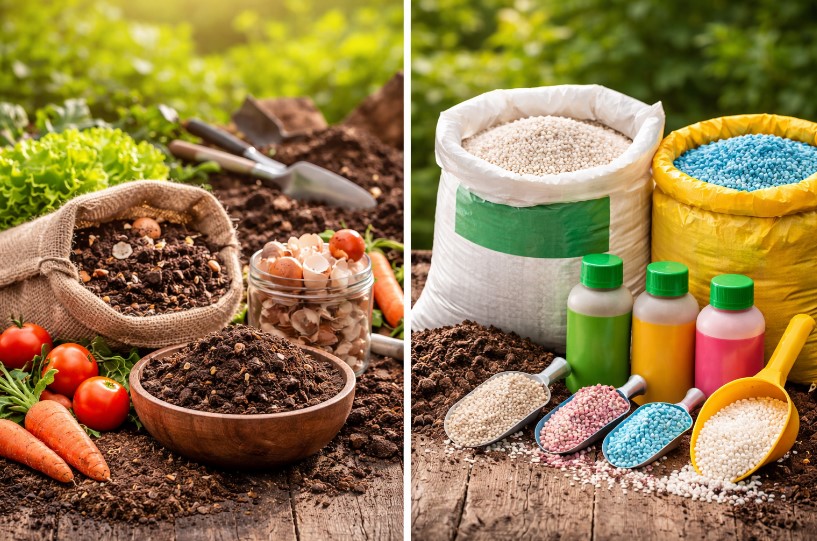
Introduction to Fertilizers in Modern Agriculture
Fertilizers play a crucial role in agriculture by supplying essential nutrients that plants need to grow, develop, and produce high yields. As global food demand continues to rise, farmers rely heavily on fertilizers to maintain soil productivity and ensure consistent crop output.
However, the debate between organic and chemical fertilizers has become increasingly important. While both types aim to improve plant growth, they differ significantly in composition, impact on soil health, environmental effects, and long-term sustainability.
Understanding these differences is essential for making informed decisions in farming and gardening practices.
What Are Organic Fertilizers?
Organic fertilizers are derived from natural sources such as plant materials, animal waste, and composted organic matter. They improve soil fertility by adding nutrients in a natural form while also enhancing soil structure.
Common examples include:
- Compost
- Manure
- Bone meal
- Green manure
- Vermicompost
These fertilizers release nutrients slowly, which supports steady plant growth and improves soil health over time.
What Are Chemical Fertilizers?
Chemical fertilizers, also known as synthetic or inorganic fertilizers, are manufactured using chemical processes. They are designed to provide specific nutrients in precise amounts for quick plant absorption.
Common types include:
- Nitrogen-based fertilizers
- Phosphorus fertilizers
- Potassium fertilizers
A well-known example is Urea, widely used to boost plant growth due to its high nitrogen content.
These fertilizers act quickly and are often used to increase crop yield in a short period.
Key Nutrients Required for Plant Growth
Plants require three primary nutrients, often referred to as NPK:
- Nitrogen (N): Supports leaf growth
- Phosphorus (P): Promotes root development
- Potassium (K): Enhances overall plant health
Chemical fertilizers usually provide these nutrients in concentrated forms. In contrast, organic fertilizers supply them gradually along with additional micronutrients.
Differences in Nutrient Release
One of the main differences between organic and chemical fertilizers lies in how nutrients are released.
Organic Fertilizers
- Release nutrients slowly
- Depend on microbial activity in the soil
- Provide long-term soil enrichment
Chemical Fertilizers
- Release nutrients quickly
- Provide immediate results
- May require frequent application
As a result, organic fertilizers are better suited for long-term soil health, while chemical fertilizers are often used for quick results.
Impact on Soil Health
Soil health is a critical factor in sustainable agriculture.
Organic fertilizers:
- Improve soil structure
- Increase water retention
- Promote beneficial microorganisms
Chemical fertilizers:
- Provide nutrients but do not improve soil structure
- May reduce microbial activity over time
- Can lead to soil degradation if overused
Therefore, organic fertilizers contribute to building healthy, living soil, while chemical fertilizers mainly focus on plant nutrition.
Environmental Impact
The environmental effects of fertilizers are a major concern.
Organic fertilizers:
- Are eco-friendly
- Reduce pollution
- Support biodiversity
Chemical fertilizers:
- May cause water pollution through runoff
- Can contribute to soil and air pollution
- May lead to nutrient imbalance in ecosystems
Excessive use of chemical fertilizers has been linked to issues like water contamination and reduced soil fertility over time.
Cost and Availability
Cost is an important factor for farmers.
Organic fertilizers:
- Often cheaper if locally produced
- Require more labor for preparation and application
Chemical fertilizers:
- Easily available in markets
- Provide quick results but can be expensive over time
Farmers often choose based on budget, availability, and farming goals.
Ease of Use and Application
Chemical fertilizers are generally easier to apply because they come in ready-to-use forms. They provide predictable results, which is why they are widely used in large-scale farming.
On the other hand, organic fertilizers require more effort. They may need preparation, composting, and proper timing for application. However, they offer long-term benefits that outweigh the initial effort.
Crop Yield and Productivity
Chemical fertilizers are known for increasing crop yield quickly. They are especially useful in intensive farming where high productivity is required.
Organic fertilizers may produce slightly lower yields in the short term. However, over time, they improve soil fertility, which can lead to stable and sustainable production.
Long-Term Sustainability
Sustainability is a key concern in modern agriculture.
Organic fertilizers:
- Support long-term soil health
- Reduce environmental damage
- Promote sustainable farming practices
Chemical fertilizers:
- Offer short-term productivity
- May harm soil and environment if overused
Balancing both approaches is often considered the most effective strategy.
Role in Organic Farming
Organic fertilizers are essential in organic farming systems. These systems avoid synthetic chemicals and focus on natural inputs to maintain soil fertility.
Organic farming emphasizes:
- Soil health
- Environmental protection
- Sustainable crop production
Chemical fertilizers, however, are not permitted in certified organic farming practices.
Government and Agricultural Practices
Many governments promote balanced fertilizer use through policies and awareness programs. Farmers are encouraged to use organic methods along with controlled chemical inputs.
This integrated approach helps:
- Maintain soil fertility
- Increase crop productivity
- Reduce environmental impact
Detailed Comparison Between Organic and Chemical Fertilizers
Understanding the practical differences between organic and chemical fertilizers helps in making better farming decisions. Although both serve the same purpose, their impact varies in several ways.
Nutrient Availability
Organic fertilizers release nutrients slowly. Therefore, plants receive a steady supply over time. In contrast, chemical fertilizers provide nutrients instantly, which leads to quick growth but may not last long.
Soil Improvement
Organic fertilizers improve soil texture and fertility. They also support microbial life. On the other hand, chemical fertilizers mainly feed the plant but do not improve soil structure.
Environmental Safety
Organic fertilizers are eco-friendly and reduce pollution. However, chemical fertilizers may cause water contamination and soil degradation if used excessively.
Cost Efficiency
Initially, organic fertilizers may seem cost-effective, especially when prepared locally. However, they require more labor. Chemical fertilizers are convenient but may become expensive with repeated use.
Advantages of Organic Fertilizers
Organic fertilizers offer several long-term benefits. Therefore, they are widely used in sustainable farming.
- Improve soil fertility naturally
- Enhance water retention capacity
- Promote beneficial microorganisms
- Reduce environmental pollution
- Provide micronutrients along with major nutrients
In addition, organic fertilizers support the principles of Sustainable Agriculture, which focuses on long-term productivity without harming the environment.
Disadvantages of Organic Fertilizers
Despite their benefits, organic fertilizers also have some limitations.
- Slow nutrient release
- Require larger quantities
- Labor-intensive preparation
- Results may take time to appear
Therefore, they may not be suitable for situations requiring immediate nutrient supply.
Advantages of Chemical Fertilizers
Chemical fertilizers are popular due to their efficiency and quick action.
- Provide immediate nutrients
- Easy to apply and store
- Require smaller quantities
- Increase crop yield quickly
For example, fertilizers containing Ammonium Nitrate are widely used for rapid plant growth.
Disadvantages of Chemical Fertilizers
However, chemical fertilizers come with certain risks.
- Can degrade soil quality over time
- Reduce beneficial microorganisms
- Cause water pollution through runoff
- May lead to nutrient imbalance
As a result, excessive use can harm both the environment and long-term productivity.
Impact on Soil Microorganisms
Soil microorganisms play a vital role in nutrient cycling and plant health.
Organic fertilizers:
- Increase microbial activity
- Support natural nutrient breakdown
- Improve soil biodiversity
Chemical fertilizers:
- May reduce microbial diversity
- Disrupt natural soil processes
Therefore, maintaining microbial balance is essential for sustainable farming.
Water Retention and Soil Structure
Soil structure affects how well it holds water and nutrients.
Organic fertilizers:
- Improve soil texture
- Increase water retention
- Reduce soil erosion
Chemical fertilizers:
- Do not improve soil structure
- May lead to soil compaction over time
Thus, organic inputs are better for maintaining soil health.
Environmental Concerns and Pollution
Environmental impact is one of the biggest differences between the two.
Chemical fertilizers can contribute to issues like Eutrophication, where excess nutrients in water bodies cause algal blooms and harm aquatic life.
In contrast, organic fertilizers release nutrients slowly, which reduces the risk of runoff and pollution.
Crop Quality and Nutritional Value
The type of fertilizer used can influence crop quality.
Organic fertilizers:
- May improve taste and nutritional value
- Support natural growth processes
Chemical fertilizers:
- Focus on rapid growth
- May not enhance nutritional quality significantly
Therefore, organic farming is often preferred for high-quality produce.
Use in Different Farming Systems
Different farming systems require different approaches.
Organic Farming
Relies completely on natural inputs and avoids synthetic chemicals.
Conventional Farming
Uses chemical fertilizers for high productivity.
Integrated Farming
Combines both organic and chemical fertilizers for balanced results.
This integrated method is becoming popular as it offers both productivity and sustainability.
Long-Term vs Short-Term Benefits
Organic fertilizers:
- Provide long-term soil health
- Support sustainable production
Chemical fertilizers:
- Deliver short-term yield improvement
- Require continuous use
Therefore, the choice depends on whether the focus is immediate results or long-term sustainability.
Practical Challenges for Farmers
Farmers often face practical challenges when choosing fertilizers.
Organic fertilizers:
- Require time and effort
- May not meet high nutrient demand quickly
Chemical fertilizers:
- Easy to use
- May increase dependency over time
Balancing these factors is important for effective farming.
Government Support and Awareness
Governments and agricultural organizations promote balanced fertilizer use. Many programs encourage farmers to adopt organic practices along with controlled chemical use.
This approach helps:
- Improve soil health
- Maintain productivity
- Reduce environmental damage
Choosing the Right Approach
There is no single correct answer to which fertilizer is better. The choice depends on:
- Type of crop
- Soil condition
- Climate
- Farming goals
- Budget
In many cases, combining both methods provides the best results.
Choosing the Best Fertilizer for Your Needs
By now, it’s clear that both organic and chemical fertilizers have their place in agriculture. However, the “better” option depends on your specific goals.
If your priority is long-term soil health and sustainability, organic fertilizers are the better choice. On the other hand, if you need quick results and higher short-term yield, chemical fertilizers may be more suitable.
Therefore, the decision should be based on:
- Type of crops
- Soil condition
- Farming scale
- Budget and resources
In many cases, a balanced approach works best.
Integrated Nutrient Management: A Balanced Approach
Instead of choosing one over the other, many experts recommend combining both methods. This approach is known as Integrated Nutrient Management.
It involves:
- Using organic fertilizers to improve soil structure
- Applying chemical fertilizers in controlled amounts
- Maintaining nutrient balance in the soil
As a result, farmers can achieve both productivity and sustainability. This method aligns well with modern practices in Sustainable Agriculture.
Best Practices for Using Organic Fertilizers
To get the most out of organic fertilizers, proper usage is essential.
First, ensure the compost or manure is well-decomposed. This improves nutrient availability.
Next, apply it at the right time, preferably before planting.
Also, use adequate quantities based on soil needs.
In addition, regular soil testing helps determine nutrient levels. Therefore, farmers can adjust inputs accordingly.
Best Practices for Using Chemical Fertilizers
Chemical fertilizers should be used carefully to avoid negative effects.
- Apply the correct dosage
- Avoid overuse
- Follow recommended schedules
- Combine with organic matter when possible
For example, controlled use of Urea can boost plant growth without harming the soil when applied properly.
Soil Testing and Nutrient Management
Soil testing is a crucial step in modern farming. It helps identify nutrient deficiencies and guides fertilizer application.
Benefits include:
- Accurate nutrient management
- Reduced waste of fertilizers
- Improved crop yield
- Better soil health
Therefore, regular soil analysis should be part of every farming plan.
Environmental Responsibility in Fertilizer Use
With growing environmental concerns, responsible fertilizer use is more important than ever.
Organic fertilizers:
- Reduce pollution
- Improve biodiversity
- Support eco-friendly farming
Chemical fertilizers:
- Should be used in limited quantities
- Require proper management to prevent runoff
For instance, improper use can contribute to Soil Degradation and water pollution. Therefore, awareness and control are essential.
Economic Considerations for Farmers
Cost plays a major role in fertilizer selection.
Organic fertilizers:
- Low cost if locally available
- Higher labor requirement
Chemical fertilizers:
- Higher initial cost
- Lower labor effort
- Quick return on investment
Therefore, farmers often choose based on financial capacity and farming goals.
Future Trends in Fertilizer Use
Agriculture is evolving with new technologies and sustainable practices.
Future trends include:
- Increased use of organic inputs
- Development of bio-fertilizers
- Precision farming techniques
- Reduced dependency on chemicals
These trends aim to balance productivity with environmental protection.
Real-World Application: What Works Better?
In practical farming, the answer is not always simple.
- For small-scale and organic farming, organic fertilizers work better
- For large-scale commercial farming, chemical fertilizers are often preferred
- For sustainable and balanced farming, a combination is most effective
Therefore, the best approach depends on the situation rather than a single universal solution.
Key Takeaways
- Organic fertilizers improve soil health and sustainability
- Chemical fertilizers provide quick and efficient results
- Overuse of chemicals can harm the environment
- Organic methods require time and consistency
- A balanced approach often delivers the best outcomes
Conclusion
In conclusion, both organic and chemical fertilizers have their advantages and limitations. While chemical fertilizers deliver fast results, organic fertilizers build long-term soil health and sustainability.
Therefore, the best solution is not choosing one over the other but using them wisely. By adopting a balanced approach, farmers can achieve higher productivity while protecting the environment for future generations.
FAQs:
There is no single answer. Organic fertilizers are better for long-term soil health, while chemical fertilizers provide quick results. A balanced approach often works best.
Yes, organic fertilizers improve soil structure, increase water retention, and promote beneficial microorganisms, making the soil healthier over time.
Farmers use chemical fertilizers because they provide immediate nutrients and help increase crop yield quickly, especially in large-scale farming.
Excessive use can cause environmental issues like water pollution and soil damage. Therefore, controlled and proper use is important.