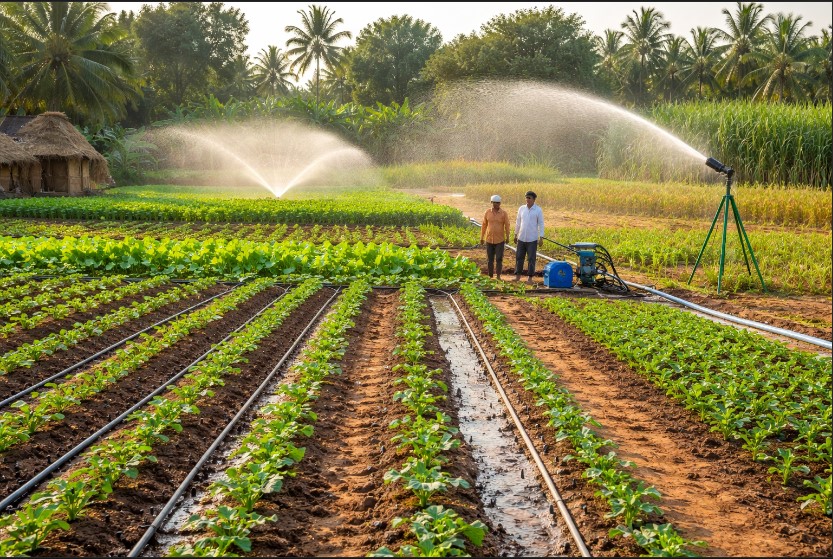
Introduction
India is an agrarian economy where agriculture plays a vital role in livelihoods, employment, and food security. However, one of the biggest challenges faced by Indian agriculture is water availability and efficient irrigation. A large portion of farmland still depends on monsoon rainfall, making crop production uncertain and vulnerable to climate variability. Before the launch of major irrigation schemes, nearly 54% of agricultural land in India was rain-fed, highlighting the urgent need for structured irrigation support.
To address these challenges, the Government of India has introduced several policies, subsidies, and schemes aimed at improving irrigation infrastructure, promoting water conservation, and encouraging modern irrigation techniques such as drip and sprinkler systems.
This blog explores the various government initiatives supporting irrigation methods in India, their objectives, benefits, and impact on farmers.
Importance of Irrigation in Indian Agriculture
Irrigation is essential for ensuring stable crop production, especially in a country like India where rainfall is seasonal and unevenly distributed.
Key Reasons Why Irrigation is Important:
- Ensures Crop Productivity
Adequate irrigation leads to higher yields and multiple cropping cycles. - Reduces Dependence on Monsoon
Farmers can grow crops even during dry seasons. - Supports High-Value Crops
Irrigation enables cultivation of fruits, vegetables, and cash crops. - Enhances Rural Economy
Increased production leads to higher farmer income and employment. - Promotes Sustainable Farming
Efficient irrigation methods conserve water and reduce wastage.
Types of Irrigation Methods Supported by Government
The government promotes both traditional and modern irrigation methods, but special emphasis is placed on water-efficient technologies.
Traditional Irrigation Methods
- Canal irrigation
- Tank irrigation
- Well irrigation
These methods are still widely used but often lead to water wastage.
Modern Irrigation Methods
- Drip irrigation
- Sprinkler irrigation
- Micro irrigation systems
Modern systems deliver water directly to plant roots, significantly reducing wastage and improving efficiency.
Government schemes strongly promote these modern methods under the concept of “More Crop Per Drop”.
Major Government Schemes Supporting Irrigation
Pradhan Mantri Krishi Sinchayee Yojana (PMKSY)
One of the most important irrigation schemes in India is the Pradhan Mantri Krishi Sinchayee Yojana (PMKSY), launched in 2015.
Objectives of PMKSY:
- Expand irrigation coverage
- Improve water-use efficiency
- Reduce water wastage
- Promote sustainable agriculture
The scheme focuses on the vision of:
Key Components of PMKSY:
Per Drop More Crop (PDMC)
- Promotes micro irrigation (drip and sprinkler)
- Provides subsidies to farmers
- Improves water efficiency at farm level
Farmers can receive 45%–55% subsidy, with higher benefits for small and marginal farmers.
In some cases and states, subsidies can go even higher, reaching up to 90% for advanced irrigation systems.
Har Khet Ko Pani
- Ensures irrigation access to all agricultural land
- Focuses on expanding irrigation infrastructure
Accelerated Irrigation Benefit Programme (AIBP)
- Speeds up completion of large irrigation projects
- Focuses on drought-prone areas
Watershed Development
- Promotes rainwater harvesting
- Improves groundwater recharge
Micro Irrigation Fund (MIF)
The Micro Irrigation Fund (MIF) was launched in 2018 to further boost irrigation efficiency.
Key Features:
- Managed by NABARD
- Provides financial assistance to states
- Encourages adoption of drip and sprinkler irrigation
The fund supports expansion of micro irrigation and helps states implement large-scale irrigation projects effectively.
Modernization of Irrigation Infrastructure
The government has also introduced modernization initiatives to improve irrigation systems.
Example: M-CADWM Scheme (2025)
- Focuses on modernizing canal irrigation systems
- Introduces pressurized pipe networks
- Supports micro irrigation at farm level
This initiative aims to improve water use efficiency and delivery systems across multiple states.
State Government Initiatives
Apart from central schemes, state governments also provide additional support:
Examples:
- Extra subsidies on drip irrigation
- Free or subsidized electricity for irrigation pumps
- Solar-powered irrigation systems
- Lift irrigation schemes
For instance, some states offer up to 50% subsidy on solar pumps, reducing irrigation costs and promoting renewable energy use.
Subsidies for Modern Irrigation Methods
Government subsidies play a crucial role in encouraging farmers to adopt advanced irrigation systems.
Types of Subsidies:
- Drip Irrigation Subsidy
- Direct water supply to plant roots
- Saves water and increases yield
- Sprinkler Irrigation Subsidy
- Suitable for uneven land
- Covers large areas efficiently
- Solar Pump Subsidy
- Reduces electricity costs
- Promotes sustainable irrigation
Subsidy Structure:
- Small & marginal farmers: up to 55% subsidy
- Other farmers: around 45% subsidy
- Additional state incentives available
- Special regions receive higher support
Benefits of Government Support in Irrigation
Government initiatives have significantly transformed Indian agriculture.
Water Conservation
Micro irrigation systems can save 40–80% water compared to traditional methods.
Increased Crop Yield
Efficient irrigation leads to better plant growth and higher productivity.
Cost Reduction
Subsidies reduce initial investment for farmers.
Climate Resilience
Irrigation helps farmers cope with droughts and irregular rainfall.
Improved Farmer Income
Higher yields and reduced costs lead to better profitability.
Challenges in Implementation
Despite strong government support, several challenges remain:
Lack of Awareness
Many farmers are unaware of available schemes.
High Initial Cost
Even after subsidies, installation costs can be high.
Technical Knowledge Gap
Farmers may lack training to use modern systems effectively.
Infrastructure Issues
Water distribution systems are still underdeveloped in some regions.
Maintenance Problems
Improper maintenance can reduce system efficiency.
Implementation of Irrigation Schemes in India
While the Government of India has introduced several well-structured irrigation schemes, their success largely depends on effective implementation at the ground level.
Institutional Framework
Implementation involves coordination among multiple bodies:
- Central Government Ministries – Policy formulation and funding
- State Governments – Execution and monitoring
- NABARD (National Bank for Agriculture and Rural Development) – Financial support and credit facilitation
- Local Authorities & Panchayats – Field-level implementation
This multi-layered structure ensures that schemes reach farmers across diverse regions.
Role of Technology in Irrigation Development
Technology is playing a transformative role in improving irrigation efficiency in India.
Smart Irrigation Systems
- Use of sensors to monitor soil moisture
- Automated water delivery systems
- Reduction in water wastage
Geographic Information System (GIS)
- Helps in mapping water resources
- Identifies drought-prone areas
- Supports better planning
Mobile Applications
Farmers can now access irrigation-related information through apps that provide:
- Weather updates
- Water availability data
- Scheme details and application processes
Impact of Government Irrigation Support
Government initiatives have led to measurable improvements in Indian agriculture.
Expansion of Irrigated Area
Millions of hectares of land have been brought under irrigation through schemes like PMKSY.
Adoption of Micro Irrigation
There has been a significant increase in the use of drip and sprinkler systems, especially in water-scarce regions.
Improved Agricultural Productivity
Farmers using modern irrigation methods report higher yields and better crop quality.
Water Use Efficiency
Efficient irrigation systems ensure optimal use of available water resources.
Employment Generation
Irrigation projects create jobs in construction, maintenance, and agriculture.
Case Studies of Successful Implementation
Andhra Pradesh – Leader in Micro Irrigation
Andhra Pradesh has emerged as a leader in micro irrigation adoption.
Key Achievements:
- Large-scale use of drip irrigation
- Government subsidies encouraging farmers
- Significant water savings and yield improvement
Gujarat – Water Management Model
Gujarat has implemented innovative irrigation practices such as:
- Check dams
- Rainwater harvesting
- Efficient canal systems
These initiatives have transformed dry regions into productive agricultural zones.
Maharashtra – Drip Irrigation for Cash Crops
Farmers in Maharashtra have widely adopted drip irrigation for crops like:
- Sugarcane
- Grapes
- Pomegranates
This has led to higher income and efficient water usage.
Challenges in Irrigation Development
Despite progress, several challenges continue to affect irrigation systems in India.
Regional Disparities
Some states have better irrigation infrastructure than others, leading to uneven development.
Groundwater Depletion
Excessive use of groundwater for irrigation has caused a decline in water tables.
Climate Change
Erratic rainfall patterns and droughts impact irrigation planning.
Financial Constraints
Small farmers often struggle to invest in modern irrigation systems even with subsidies.
Maintenance Issues
Lack of proper maintenance reduces the efficiency of irrigation systems.
Government Initiatives for Sustainable Irrigation
To address these challenges, the government is promoting sustainable practices.
Rainwater Harvesting
Encouraged under watershed development programs.
Solar Irrigation Pumps
Reduce dependence on electricity and diesel.
Water Conservation Campaigns
Promote awareness among farmers about efficient water use.
Integrated Water Resource Management
Ensures balanced use of surface and groundwater resources.
Policy Reforms and Future Prospects
India is continuously evolving its irrigation policies to meet future demands.
Key Policy Directions:
Focus on “Per Drop More Crop”
- Maximizing output with minimal water usage
Expansion of Micro Irrigation
- Target to cover more agricultural land
Public-Private Partnerships (PPP)
- Involving private players in irrigation projects
Digital Agriculture
- Use of AI and data analytics for irrigation planning
Climate-Resilient Farming
- Developing irrigation systems adaptable to climate change
Recommendations for Improving Irrigation Support
To enhance the effectiveness of government initiatives, the following steps are essential:
Increase Farmer Awareness
- Conduct training programs
- Use digital platforms for information dissemination
Simplify Subsidy Procedures
- Reduce paperwork
- Ensure timely disbursement
Strengthen Infrastructure
- Improve canals and water storage systems
Promote Community Participation
- Encourage water user associations
Enhance Research and Development
- Invest in innovative irrigation technologies
Role of Farmers in Efficient Irrigation
Farmers also play a crucial role in ensuring the success of irrigation systems.
Best Practices for Farmers:
- Use water-efficient irrigation methods
- Regularly maintain irrigation systems
- Adopt crop patterns suitable for local water availability
- Participate in government programs
Conclusion
Government support for irrigation methods in India has significantly contributed to agricultural growth and sustainability. Through schemes like PMKSY, financial assistance, and technological advancements, India is moving towards a more efficient and resilient agricultural system.
However, to fully realize the benefits, it is essential to address existing challenges, improve implementation, and ensure active participation from farmers and stakeholders.
With continued efforts and innovation, India can achieve its goal of water-secure and sustainable agriculture, ensuring food security and improved livelihoods for millions of farmers.
FAQs:
The Pradhan Mantri Krishi Sinchayee Yojana (PMKSY) is the primary scheme aimed at improving irrigation coverage and efficiency.
Farmers can receive 45%–55% subsidy, with higher benefits for small and marginal farmers.
Micro irrigation includes systems like drip and sprinkler irrigation that deliver water directly to plants efficiently.
It ensures consistent water supply, increases crop yield, and reduces dependence on rainfall.
Future trends include smart irrigation, digital monitoring, and climate-resilient systems