India is a land of rich ecological diversity. From snowy mountains to tropical coastlines, the country offers a wide range of natural landscapes. As a result, its forests vary greatly in structure, climate, and vegetation. These forests are not only home to wildlife but also play a key role in climate regulation, water conservation, and human livelihoods.
To better understand this diversity, forests in India are classified based on factors such as rainfall, temperature, altitude, and soil type. One of the most widely accepted classifications was developed by Champion and Seth. Their system helps us study forests in a clear and organized way.
In this part, we will explore the major types of forests in India along with their key features, distribution, and importance.
Tropical Evergreen Forests
Overview
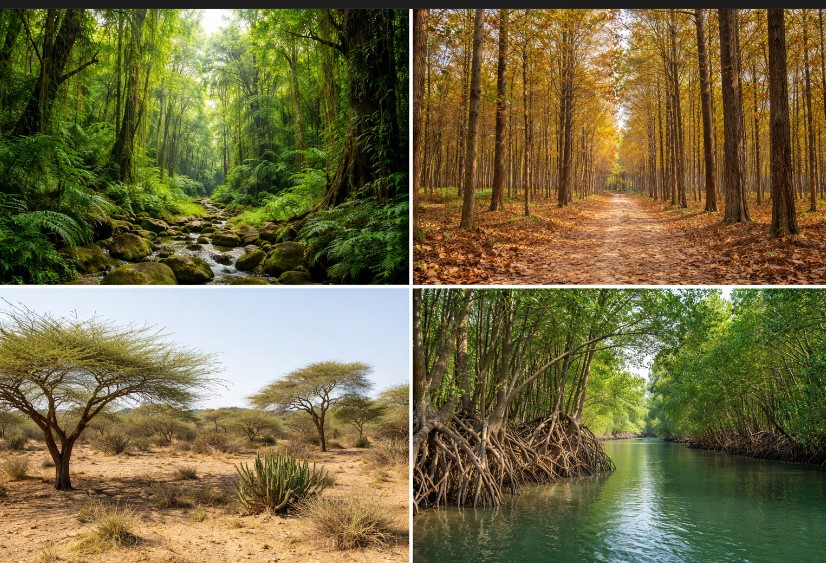
To begin with, tropical evergreen forests are among the most dense and rich ecosystems in India. These forests remain green throughout the year because the trees do not shed their leaves at the same time.
Key Features
- First of all, these forests receive heavy rainfall, usually more than 200 cm annually
- In addition, they have a thick, multi-layered structure with tall trees
- Moreover, they support a very high level of biodiversity
- As a result, sunlight hardly reaches the forest floor
Distribution
These forests are mainly found in:
- Western Ghats
- Andaman and Nicobar Islands
- Northeastern states such as Assam, Meghalaya, and Nagaland
Common Flora
For example, common trees include ebony, mahogany, rosewood, and bamboo.
Ecological Importance
Most importantly, these forests act as major carbon sinks. They also help regulate climate and support many rare species.
Tropical Deciduous Forests
Overview
Next, tropical deciduous forests are the most common type of forests in India. They are also known as monsoon forests because they depend on seasonal rainfall.
Key Features
- Generally, these forests receive rainfall between 100 and 200 cm
- During the dry season, trees shed their leaves to conserve water
- Compared to evergreen forests, they are less dense
Types
There are two main types:
- Moist deciduous forests
- Dry deciduous forests
Distribution
These forests are widely spread across:
- Madhya Pradesh
- Uttar Pradesh
- Odisha
- Parts of Maharashtra and Karnataka
Common Flora
In particular, teak, sal, sandalwood, and peepal trees are commonly found.
Economic Importance
Therefore, these forests are very important for timber and fuelwood. They also support a wide range of animals.
Tropical Thorn Forests
Overview
On the other hand, tropical thorn forests grow in dry and harsh regions. These forests have sparse vegetation that is specially adapted to low rainfall.
Key Features
- Typically, these areas receive less than 70 cm of rainfall
- As a result, vegetation is limited to small trees and shrubs
- Furthermore, plants have deep roots and small leaves to reduce water loss
Distribution
These forests are mainly found in:
- Rajasthan
- Gujarat
- Parts of Punjab and Haryana
Common Flora
For instance, acacia, cactus, date palm, and babul are common species.
Ecological Role
Consequently, these forests help prevent soil erosion and desert expansion.
Montane Forests
Overview
Moving on, montane forests are found in mountainous regions. Their vegetation changes with altitude, which makes them unique.
Key Features
- As altitude increases, temperature decreases
- Therefore, different types of vegetation are found at different heights
- In addition, these forests include temperate and alpine types
Distribution
They are mainly located in:
- Himalayas
- Southern hill ranges such as the Nilgiri Hills
Types
These forests can be divided into:
- Montane wet temperate forests
- Himalayan temperate forests
- Sub-alpine forests
- Alpine forests
Common Flora
Common trees include pine, deodar, fir, and oak.
Importance
Importantly, these forests act as water sources for many rivers. They also support wildlife adapted to cold climates.
Mangrove Forests
Overview
Finally, mangrove forests are found in coastal and tidal areas. These forests grow in salty and waterlogged soil.
Key Features
- These forests can tolerate high salt levels
- In addition, they have special roots that help them breathe
- Moreover, they can survive in areas with regular flooding
Distribution
Major regions include:
- Sundarbans
- Coastal areas of West Bengal, Odisha, Andhra Pradesh, and Tamil Nadu
Common Flora
For example, sundari, Rhizophora, and Avicennia are widely found.
Ecological Importance
As a result, mangroves protect coastal areas from storms and erosion. They also provide breeding grounds for fish and other marine life.
Littoral and Swamp Forests
Overview
To begin with, littoral and swamp forests are found along coastlines and in low-lying wet areas. These forests grow in regions where the soil is waterlogged for most of the year.
Key Features
- Generally, these forests are found in areas with high humidity and rainfall
- The soil is often marshy and rich in organic matter
- In addition, the vegetation is dense and adapted to wet conditions
Distribution
These forests are mainly found in:
- Coastal regions of Kerala and West Bengal
- River deltas and lowlands, especially near the Ganga River and Brahmaputra River
Common Flora
For example, species such as palms, reeds, and swamp grasses are common.
Importance
As a result, these forests help in water purification and provide habitats for aquatic species.
Subtropical Forests
Overview
Next, subtropical forests are found in regions with moderate climate conditions. These forests are less dense than tropical forests but still support a variety of plant and animal life.
Key Features
- Typically found in areas with moderate rainfall
- In addition, they experience seasonal temperature changes
- Vegetation includes both evergreen and deciduous species
Distribution
These forests occur mainly in:
- Lower regions of the Himalayas
- Parts of Himachal Pradesh and Uttarakhand
Common Flora
Common trees include pine, sal, and oak.
Ecological Role
Therefore, these forests act as a transition zone between tropical and temperate forests.
Temperate Forests
Overview
Moving forward, temperate forests are found in cooler regions, mainly in higher altitudes. These forests have well-defined seasons, including cold winters.
Key Features
- Moderate rainfall and cool temperatures
- Trees shed leaves in autumn (in some areas)
- In addition, coniferous trees are also common
Distribution
These forests are mainly located in:
- Higher altitudes of the Himalayas
- Regions in Jammu and Kashmir and Sikkim
Common Flora
For instance, oak, maple, pine, and fir trees are widely found.
Importance
As a result, these forests help regulate climate and support unique wildlife species.
Alpine Vegetation
Overview
Furthermore, alpine vegetation is found at very high altitudes, above the tree line. In these regions, harsh climatic conditions limit plant growth.
Key Features
- Extremely low temperatures
- Short growing seasons
- In addition, vegetation mainly consists of grasses, mosses, and lichens
Distribution
These regions are found in:
- The upper reaches of the Himalayas
Common Flora
Examples include alpine grasses, dwarf shrubs, and medicinal plants.
Ecological Importance
Consequently, alpine vegetation helps prevent soil erosion and supports specialized wildlife.
Importance of Forests in India
Environmental Importance
First of all, forests help maintain ecological balance. They absorb carbon dioxide and release oxygen, which helps control climate change. Moreover, they protect soil from erosion and help in maintaining the water cycle.
Economic Importance
In addition, forests provide valuable resources such as timber, fuelwood, medicinal plants, and raw materials for industries. Therefore, they support millions of livelihoods in India.
Social Importance
Forests are also important for tribal communities who depend on them for food, shelter, and cultural practices. Furthermore, forests offer recreational and tourism opportunities.
Challenges Facing Forests in India
Deforestation
One of the biggest challenges is deforestation. Trees are cut down for agriculture, urban development, and industrial use. As a result, forest cover is decreasing.
Climate Change
In addition, climate change is affecting forest ecosystems. Changes in temperature and rainfall patterns can harm plant and animal species.
Overgrazing and Pollution
Moreover, overgrazing by livestock and pollution are damaging forest areas. These factors reduce soil quality and hinder plant growth.
Illegal Activities
Illegal logging and poaching also pose serious threats to forests and wildlife.
Conservation of Forests in India
Government Initiatives
To address these issues, the government has launched several programs. For example, policies under the Ministry of Environment, Forest and Climate Change aim to protect and manage forest resources.
Afforestation and Reforestation
Planting new trees and restoring degraded forests are key strategies. As a result, forest cover can be increased over time.
Wildlife Protection
Protected areas such as national parks and wildlife sanctuaries help conserve biodiversity.
Public Awareness
Finally, spreading awareness among people is essential. When individuals understand the value of forests, they are more likely to protect them.
Final Thoughts
In summary, India’s forests are not just collections of trees but living ecosystems that support life in many forms. From the dense greenery of the Western Ghats to the fragile alpine regions of the Himalayas, each forest type plays a vital role in maintaining nature’s balance.
Moreover, these forests provide us with clean air, water, food, and livelihoods. At the same time, they protect biodiversity and help fight climate change. However, increasing human activities and environmental challenges are putting these valuable resources at risk.
Therefore, it is important for both the government and individuals to take responsibility for forest conservation. Simple actions like planting trees, reducing waste, and spreading awareness can make a big difference. In the long run, protecting forests is not just about saving nature—it is about securing our own future.
Ultimately, a sustainable relationship with forests will ensure that future generations can continue to benefit from their richness and beauty.
FAQs:
India has several forest types, broadly classified into tropical evergreen, tropical deciduous, thorn, montane, mangrove, and others like swamp and alpine forests.
Tropical deciduous forests are the most common, covering large parts of central and northern India.
Mangrove forests are mainly found in coastal regions such as the Sundarbans, West Bengal, Odisha, Andhra Pradesh, and Tamil Nadu.
The Himalayas have montane forests, temperate forests, and alpine vegetation depending on altitude.
They support high biodiversity, regulate climate, and act as important carbon sinks.
According to general trends, Madhya Pradesh has one of the largest forest covers in India.